Case Studies
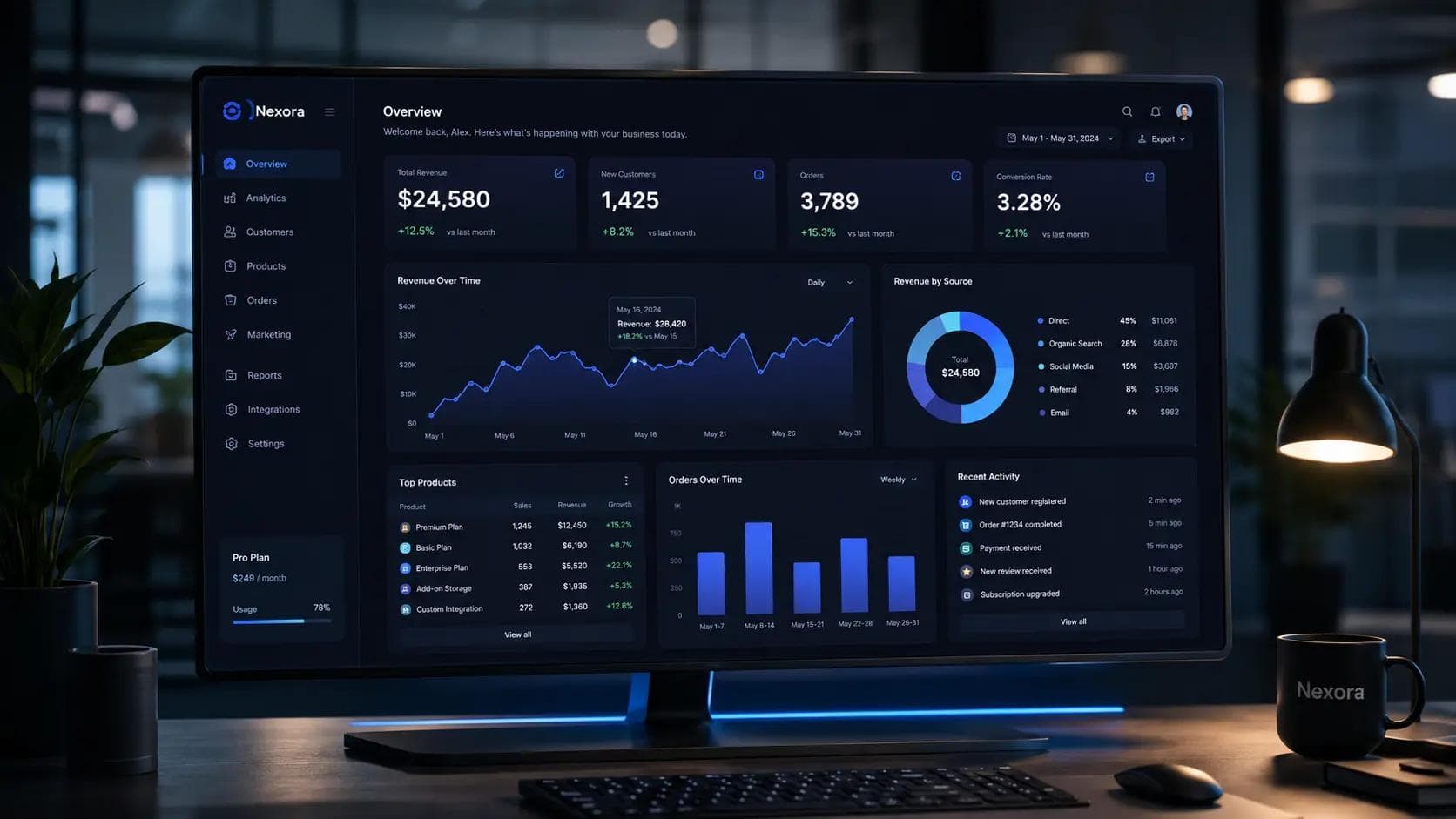
Turning Data Overload Into One Screen That Actually Answers Questions
PulseIQ Analytics helps mid-size marketing teams track campaign performance across paid, organic, and social channels from a single platform. The product worked — their data pipelines were solid, their integrations were reliable, and their customer retention was respectable. But every user interview kept surfacing the same
The dashboard had been built incrementally over three years by developers responding to individual feature requests, with no designer ever stepping back to look at the whole picture.
The result was a cluttered, cognitively exhausting interface that technically showed everything but communicated nothing. Power users had built workarounds. New users churned in the first two weeks. PulseIQ's team knew the product experience was becoming a growth ceiling — and they brought us in to tear it down and rebuild it around how their users actually think.
Strategic Implementation
& Digital Results
We opened with three weeks of discovery: user interviews with six PulseIQ customers ranging from solo media buyers to 10-person agency teams, a full component audit, and a competitive analysis of dashboards that people actually enjoy using (Notion, Linear, Stripe). The insight that shaped everything: users didn't need more data — they needed faster answers.
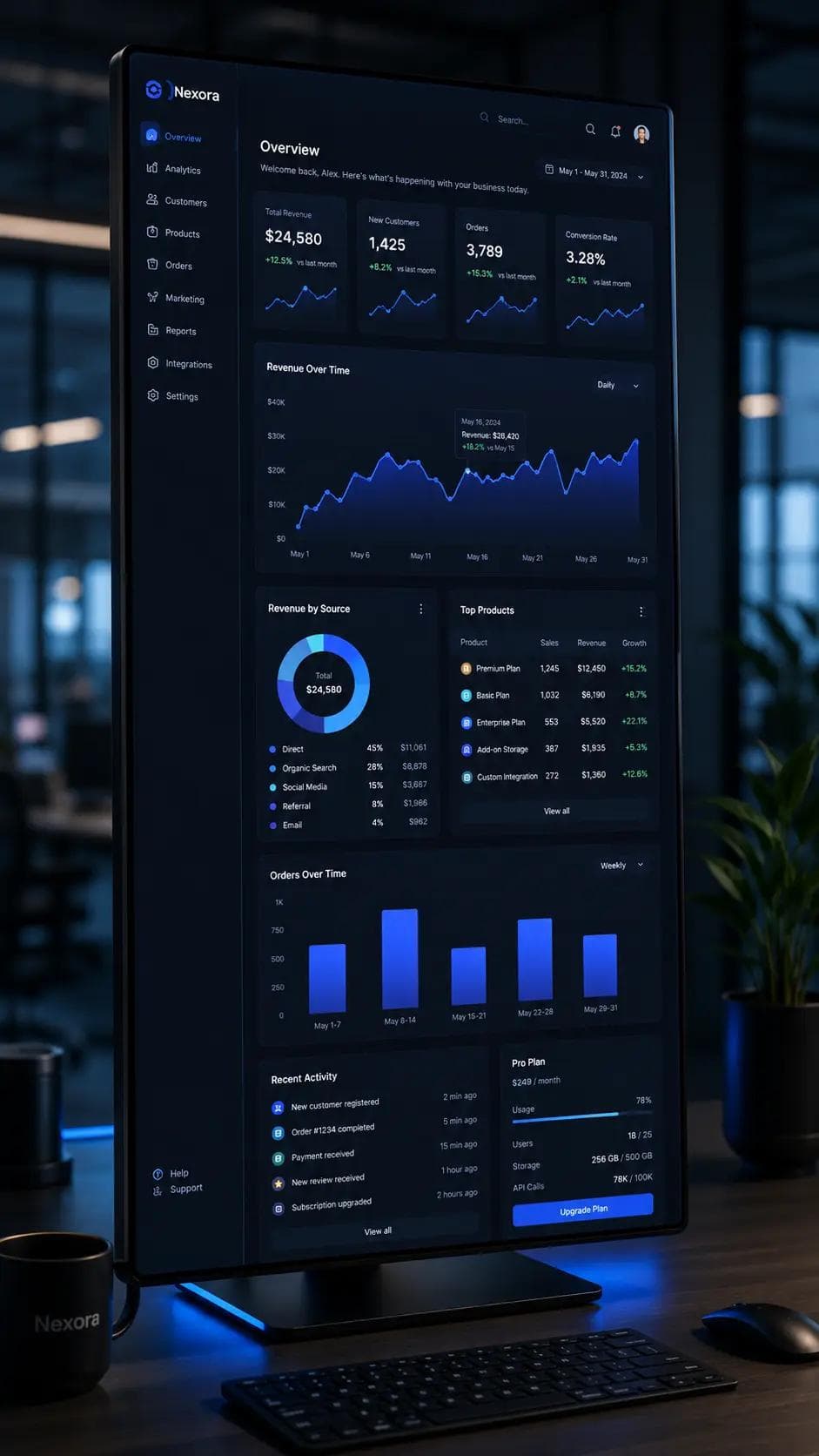
We restructured the entire information architecture around a "Command Center" model: one primary view that surfaced the five metrics each user cared about most, with everything else accessible within two clicks. We introduced a lightweight AI-summary card at the top of each report view — a plain-English snapshot generated from live data, e.g., "Paid social CPL is up 18% this week — Meta is the outlier." This single feature reduced support tickets about "not knowing what to look at" by 40%.
On the technical side, we rebuilt the frontend in React with a unified component library (37 reusable components, fully documented in Storybook), and refactored the data-fetching layer to use parallel async calls with skeleton loading states. Dashboard load time dropped from an average of 11 seconds to under 2.4 seconds. PulseIQ reported a 34% improvement in new user activation within the first 30 days of the redesigned product going live.
Background
PulseIQ Analytics helps mid-size marketing teams track campaign performance across paid, organic, and social channels from a single platform. The product worked — their data pipelines were solid, their integrations were reliable, and their customer retention was respectable. But every user interview kept surfacing the same
The dashboard had been built incrementally over three years by developers responding to individual feature requests, with no designer ever stepping back to look at the whole picture.
The result was a cluttered, cognitively exhausting interface that technically showed everything but communicated nothing. Power users had built workarounds. New users churned in the first two weeks. PulseIQ's team knew the product experience was becoming a growth ceiling — and they brought us in to tear it down and rebuild it around how their users actually think.
The Challenges
- Information architecture was a maze — 14 navigation items in the sidebar, no clear hierarchy between primary and secondary views, and key actions like "create report" buried three clicks deep.
- No insight layer — the dashboard displayed raw metrics but offered no contextual signals: no trend indicators, no anomaly flags, no plain-language summaries that told users what was actually happening with their campaigns.
- Inconsistent component library — buttons, cards, tables, and modals had each been built at different times by different hands. The result was a UI that felt like four different products stitched together, eroding user confidence.
- Performance degraded with scale — clients with large data sets reported dashboard load times of 9–14 seconds due to unoptimized queries and synchronous data fetching on initial render.
The Solution
We opened with three weeks of discovery: user interviews with six PulseIQ customers ranging from solo media buyers to 10-person agency teams, a full component audit, and a competitive analysis of dashboards that people actually enjoy using (Notion, Linear, Stripe). The insight that shaped everything: users didn't need more data — they needed faster answers.
We restructured the entire information architecture around a "Command Center" model: one primary view that surfaced the five metrics each user cared about most, with everything else accessible within two clicks. We introduced a lightweight AI-summary card at the top of each report view — a plain-English snapshot generated from live data, e.g., "Paid social CPL is up 18% this week — Meta is the outlier." This single feature reduced support tickets about "not knowing what to look at" by 40%.
On the technical side, we rebuilt the frontend in React with a unified component library (37 reusable components, fully documented in Storybook), and refactored the data-fetching layer to use parallel async calls with skeleton loading states. Dashboard load time dropped from an average of 11 seconds to under 2.4 seconds. PulseIQ reported a 34% improvement in new user activation within the first 30 days of the redesigned product going live.
The Competitive
Edge Delivered.
Like What You See?
Every project starts with a conversation. Let's discuss how we can bring this level of strategic digital expertise to your next business challenge.
Let's Talk